
PPF vs Ceramic Coating: Which Is Better for UAE Heat?
A black car parked outside a mall in Abu Dhabi in August gets hot enough to burn your hand. Add sand, stone chips from trucks, and the odd bird dropping, and the paint takes a beating every day. Both PPF and ceramic coating promise to protect it, but they work in very different ways.
Quick Summary
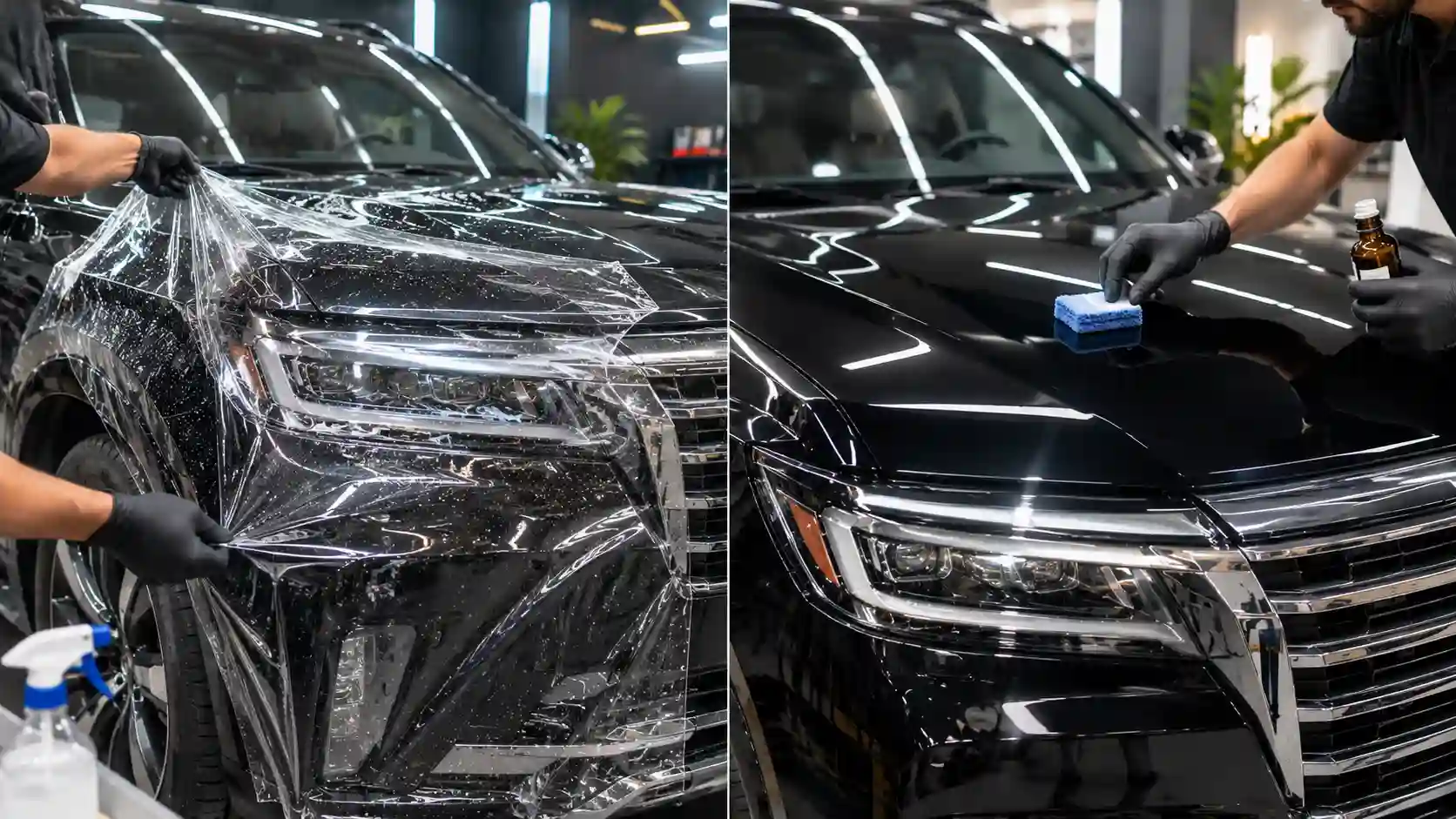
For UAE heat, paint protection film is better for physical protection and ceramic coating is better for UV, chemical resistance, and easy cleaning. PPF is thick enough to absorb stone chips and self-heals light marks in the sun. Ceramic coating is only a few microns thick. Most cars do best with both.
For UAE heat, paint protection film (PPF) is better for physical protection, while ceramic coating is better for UV resistance, chemical resistance, and easy cleaning. PPF is a thick, flexible film that absorbs stone chips and scratches, and quality films self-heal light marks when warmed by the sun.
Ceramic coating is a hard, microscopically thin layer that cannot stop impacts. For most cars in the UAE, the strongest setup is PPF on the high-impact areas and ceramic coating over the rest, or on top of the film.
How UAE Heat Attacks Car Paint
Heat on its own is only part of the problem. It works together with other UAE conditions to wear paint down faster.
Intense UV light breaks down the clear coat and fades colour, especially on roofs and bonnets. High surface temperatures soften paint slightly, so bird droppings, tree sap and insect remains etch in faster.
Sand and grit scratch the surface when wiped or blown across it. Hard water from sprinklers leaves mineral spots that bake into the finish. On highways, stone chips from trucks and construction traffic chip the front end.
A good protection choice needs to handle all of these, not just one.
The Core Difference Between PPF and Ceramic Coating
The biggest difference is thickness. A ceramic coating is typically only about 1 to 2 microns per coat, according to Turn 14 Distribution, and builds up only a few microns even with several layers. PPF is usually around 150 to 215 microns thick. The 8.5 mil film Zenfo fits is about 216 microns, roughly 50 to 100 times thicker than a ceramic coating.
| Feature | Paint protection film | Ceramic coating |
|---|---|---|
| Material | Clear thermoplastic urethane film | Liquid SiO2 or graphene-based coating that cures hard |
| Thickness | About 150 to 215 microns | About 1 to 2 microns per coat |
| Stone chip protection | Strong, absorbs impacts | Minimal |
| Self-healing | Yes, light scratches fade with heat | No |
| UV protection | Yes | Yes |
| Chemical and etch resistance | Good | Very good |
| Water beading and easy cleaning | Moderate, better with a top coat | Excellent |
| Typical lifespan | Up to 10 to 12 years with care | Multi-year with maintenance |
| Relative cost | Higher | Lower |
How Each Performs in UAE Conditions
The two products meet UAE conditions in different places. Breaking it down by threat shows where each one earns its cost.
Surface Heat and Self-Healing
This is where PPF has a real advantage in the UAE. Quality films have a top layer that softens with heat, letting light swirl marks and fine scratches flow back level. In much of the world, owners need a heat gun or hot water to trigger this. In the UAE, a few hours in the sun often does the job naturally.
Ceramic coatings handle heat well once fully cured, and graphene-enhanced formulas are generally considered more heat-tolerant. However, they do not repair scratches. Any mark that gets through stays until it is polished out.
UV and Colour Fading
Both options block UV and slow fading. Ceramic coating adds a hard, glossy layer across every panel, including areas that are rarely covered by film. PPF also blocks UV, and good films are designed not to yellow.
Cheap films, though, can yellow and crack within a few years under strong sun, so film quality matters more in the UAE than in milder climates.
Sand, Stone Chips and Highway Debris
This is PPF's main strength. A stone thrown up by a truck on a desert highway hits with enough force to chip paint through any ceramic coating. A thick film absorbs that impact and protects the paint beneath. For the front bumper, bonnet, fenders, and mirrors, nothing else offers comparable protection.
Bird Droppings and Water Spots
Ceramic coating has the edge here. Its very smooth, hydrophobic surface makes droppings and mineral deposits harder to bond and easier to rinse off. Water beads and rolls away instead of drying into spots. PPF resists etching too, and adding a ceramic top coat to the film gives it the same easy-clean behaviour.
Adhesive and Edge Stress
PPF relies on adhesive, and extreme heat tests it. Professionally installed premium film with wrapped edges holds up well. Poor installation or low-grade film can lift at edges, trap dust or bubble. This is why installation quality is as important as the film brand.
Which Should You Choose?
The right answer depends on how you use the car, how long you plan to keep it, and your budget.
New, Luxury or High-Value Cars
Factory paint is at its best when the car is new. Full-body PPF keeps it that way, protecting against chips, scratches, and door dings. Adding ceramic coating over the film makes washing easier and boosts gloss.
Daily Highway Commuters
If you regularly drive between Abu Dhabi, Dubai, and Al Ain, the front of the car takes constant stone impacts. Partial PPF on the bumper, bonnet, fenders and mirrors, with ceramic coating on the rest, gives strong protection at a lower cost than a full wrap.
Older Cars With Paint Worth Keeping
If the paint is a few years old but in decent condition, paint correction followed by ceramic coating restores gloss and adds protection at a sensible price. PPF can still be added to the front if chips are a problem.
Cars Parked Outdoors
Open parking means more UV, dust, and droppings. Ceramic coating handles these daily contaminants well. If the car is also a long-term keeper, PPF adds a layer of insurance against scratches.
| Your situation | Recommended protection |
|---|---|
| New or luxury car you plan to keep | Full-body PPF with ceramic top coat |
| Frequent highway driving | Front-end PPF plus full ceramic coating |
| Older car, good paint, tighter budget | Paint correction and ceramic coating |
| Mostly city driving, outdoor parking | Ceramic coating, optional front PPF |
| Leased car or short ownership | Ceramic coating or front-end PPF only |
Why Many Owners Choose Both
PPF and ceramic coating are not rivals. They protect against different threats, so combining them covers almost everything UAE roads throw at a car. The film absorbs impacts, and the coating on top resists stains, keeps the film glossy, and makes washing quick.
Zenfo's full-body PPF package includes exterior ceramic coating applied on top of the film, along with headlight PPF, rim coating, and nano ceramic window tint.
Caring for PPF and Ceramic Coating in Hot Weather
Both protections last longer with the right care. After ceramic coating, wait at least 7 days before the first wash while the coating fully cures. Wash with a pH-neutral shampoo and avoid automatic brush washes.
With PPF, avoid aiming a pressure washer directly at film edges, and do not use abrasive polishes on the film. A professional check every six months catches lifting edges early.
For broader habits that protect paint, our tips on how to protect your car's body apply to coated and filmed cars alike. If you are weighing up budget, our guide to ceramic coating cost breaks down what affects the price.
Frequently Asked Questions
Is PPF or ceramic coating better in hot climates?
They suit different needs. PPF is better at stopping stone chips and scratches, and it self-heals light marks in the heat. Ceramic coating is better for UV, chemical resistance, and easy cleaning. In hot climates like the UAE, combining both gives the best overall protection.
Does PPF turn yellow in the UAE sun?
Quality modern films are designed to resist yellowing, and premium brands back this with long warranties. Cheaper, older-style films can yellow and crack under strong UV. Choosing a reputable film and professional installation is the best way to avoid it.
Can ceramic coating be applied over PPF?
Yes. Applying ceramic coating on top of PPF makes the film more hydrophobic, easier to clean, and more resistant to stains. Many full-body PPF packages, including Zenfo's, already include an exterior ceramic layer over the film.
Does heat help PPF self-heal?
Yes. The top layer of quality PPF softens when warm, allowing light scratches and swirl marks to level out. In UAE conditions, sunlight on a parked car is often enough to make minor marks fade within hours.
Which lasts longer, PPF or ceramic coating?
Quality PPF generally lasts longer, often up to 10 to 12 years with proper care. Ceramic coatings offer multi-year protection but need regular maintenance and may need topping up sooner in strong sun and with outdoor parking.
Conclusion
In UAE heat, PPF and ceramic coating each solve a different problem. PPF physically shields paint from chips and scratches and heals light marks in the sun, while ceramic coating resists UV, etching, and dirt and keeps cleaning easy.
For most drivers, film on the front end and coating everywhere else delivers the best balance of protection and cost. Protect your car properly with professional paint protection film and ceramic coating from Zenfo Auto Services, with free pick-up anywhere in Abu Dhabi.
Related Services
Related Articles
Need a hand with your car?
Zenfo Auto Services, Mussafah, Abu Dhabi. Free pick-up, honest quotes.