
6 Ways of Knowing if Your Wheels Need Alignment
You let go of the steering wheel for a second on Sheikh Zayed Bridge, and the car drifts toward the next lane. Most drivers shrug it off as the road. More often, it is the first sign that the wheels are no longer pointing where they should.
Quick Summary
Six signs mean your wheels need alignment: the car pulls to one side, the steering wheel sits off-centre, tyres wear unevenly, the steering feels loose or wanders, the wheel vibrates, or tyres squeal on gentle turns. Two or more together almost always mean camber, caster, or toe has drifted.
You can tell your wheels need alignment through six signs: the car pulls to one side, the steering wheel sits off-centre when driving straight, the tyres wear unevenly, the steering feels loose or wanders, the steering wheel vibrates, or the tyres squeal on gentle turns. Any one of these is reason enough for a check. Two or more together almost always mean the camber, caster or toe angles have drifted out of factory specification.
Why Alignment Matters More Than Most Drivers Think
Misalignment rarely feels dramatic, which is why it gets ignored. The cost builds quietly in tyre wear and fuel use. Data from Michelin on commercial vehicles shows that every millimetre of toe error cuts tyre life by about 7% and raises fuel consumption by around 0.7%. A 3 mm error, which a driver may barely notice, takes roughly a fifth off a tyre's life.
Passenger cars follow the same physics. A wheel that points even slightly inward or outward is dragged sideways along the road with every turn. That scrubbing wears the tread unevenly and makes the engine work harder.
The safety side matters too. A tyre worn down on one edge has less grip and is weaker in heat. UAE Ministry of Interior figures reported by The National show 65 accidents caused by tyre blowouts on UAE roads between 2023 and 2025. Abu Dhabi Police repeatedly urge drivers to inspect tyres and not skip preventive maintenance.
The Three Angles a Wheel Alignment Sets
Alignment does not adjust the tyres themselves. It adjusts the angles of the suspension that holds them. Three angles do most of the work.
| Angle | What it is | What happens when it is wrong |
|---|---|---|
| Toe | Whether the wheels point inward or outward when seen from above | Fast, feathered wear on tyre edges and a car that pulls |
| Camber | How far the top of the wheel tilts in or out when seen from the front | Wear on the inner or outer shoulder of the tyre |
| Caster | The forward or backward tilt of the steering axis when seen from the side | Heavy or light steering, wandering, poor return to centre |
Toe is the angle that drifts most often and does the most damage to tyres. Camber and caster usually shift because a suspension or steering part is bent or worn.
Six Signs Your Wheels Need Alignment
Each of these signs can appear on its own. They become far more reliable when two or three show up together.
1. The Car Pulls to One Side
On a flat, straight road, a well-aligned car should hold its line with a light touch on the wheel. If you have to keep steering slightly left or right to stay straight, the toe or camber on one side has likely changed.
Rule out tyre pressure first. A soft tyre on one side causes the same pull. If pressures are equal and the pull remains, alignment is the next suspect. Note that some pull toward the road edge is normal on roads built with a slight camber for drainage, so test on more than one road.
2. The Steering Wheel Sits Off-Centre
When the car drives straight, the steering wheel logo should be level. If it sits tilted while the car tracks straight, the wheels and steering are no longer in agreement.
This often appears right after a sharp hit on a kerb or speed bump. It can also follow suspension or steering work that was not finished with an alignment. An off-centre wheel can confuse lane-keeping and stability systems in modern cars, so it is worth correcting even if the car feels fine.
3. Tyres Wear Unevenly
Your tyres are the most honest alignment gauge you have. Run a hand across the tread and compare the inner and outer edges. Look at all four tyres, not just one.
| Wear pattern | What it looks like | Likely alignment cause |
|---|---|---|
| Feathering | Tread ribs smooth on one side and sharp on the other | Incorrect toe |
| Inner edge wear | Inside shoulder worn down much faster | Too much negative camber or toe-out |
| Outer edge wear | Outside shoulder worn down faster | Positive camber or toe-in |
| One tyre wearing faster | A single tyre balder than the rest | A bent part on that corner |
| Cupping or scalloping | Patchy dips around the tread | Worn shocks or balancing, often with misalignment |
Centre wear on its own usually points to over-inflation, and wear on both edges to under-inflation. Those are pressure issues, not alignment issues.
4. Steering Feels Loose or Wanders
A car that wanders needs constant small corrections on the motorway. The steering may feel vague around the centre, or slow to return straight after a turn.
Caster and toe settings both affect this feel. Worn tie rod ends, ball joints and bushings can produce the same symptom, and they also stop an alignment from holding. That is why a proper check includes the steering and suspension parts, not just the angles.
5. The Steering Wheel Vibrates
Vibration through the steering wheel is more often caused by wheel balance than alignment. Still, the two are linked. Misalignment creates uneven wear, and uneven tyres then vibrate at speed.
If vibration appears at a certain speed, such as 100 to 120 km/h on the E11, balancing is the first fix. If it comes with pulling or edge wear, the car likely needs both balancing and alignment.
6. Tyres Squeal on Gentle Turns
Tyres should only squeal under hard cornering. If you hear them on slow turns in a car park or at a roundabout, the wheels may be scrubbing sideways instead of rolling cleanly.
Toe error is the usual cause. Heavily worn or low-pressure tyres can also squeal, so check pressures before booking.
What Knocks Wheels Out of Alignment
Alignment does not drift on its own. Something pushes it out, and knowing the cause helps stop it happening again.
Speed Bumps, Kerbs and Potholes
Abu Dhabi roads are generally smooth, but speed bumps are everywhere in residential areas, malls and car parks. Taking them too fast, or clipping a kerb while parking, sends a sharp load through the suspension. One hard hit can be enough to shift toe or bend a tie rod.
Construction zones and unpaved access roads around Mussafah and the city edges add rough surfaces to the mix. After any hard impact, watch for a new pull or an off-centre wheel.
Worn Suspension and Steering Parts
Bushings, ball joints, tie rod ends and control arms all wear over time. Once they develop play, the wheel angles shift under load even if the alignment was set correctly. Replacing the worn part first is the only way to make an alignment last. Our suspension repair team checks these parts before any adjustment.
Heat, Load and Modifications
UAE heat ages rubber bushings faster than in milder climates. Regularly carrying heavy loads compresses springs over time. Lowering springs, larger wheels and lift kits all change the geometry, so any modified car needs an alignment set to suit the new setup.
Alignment, Balancing or a Suspension Fault
These three problems share symptoms, and drivers often book the wrong service. This quick guide helps narrow it down before you visit.
| Symptom | Alignment | Wheel balancing | Suspension fault |
|---|---|---|---|
| Car pulls to one side | Common | Rare | Possible |
| Steering wheel off-centre | Common | No | Possible |
| Vibration at a set speed | Rare | Common | Possible |
| Uneven edge wear | Common | Rare | Possible |
| Clunks over bumps | No | No | Common |
| Bouncing or floating ride | No | No | Common |
When symptoms overlap, a full inspection is quicker and cheaper than fixing one thing and coming back for the next.
How Often to Check Your Wheel Alignment
Most carmakers do not set a fixed alignment interval, so the trigger is usually an event or a symptom. A yearly check is a sensible baseline for most UAE drivers, given the heat and frequent speed bumps.
| Situation | When to check |
|---|---|
| Normal driving | Once a year or with a major service |
| New tyres fitted | At the time of fitting |
| Hard hit on a kerb, bump or pothole | As soon as possible |
| Suspension or steering parts replaced | Straight after the repair |
| Lowered, lifted or new wheel size | After any change |
| Any of the six signs above | Within a week |
Pairing alignment with routine servicing keeps it from being forgotten. Our guide on service intervals explains how to plan the rest of your maintenance, and these tyre care tips help your tyres last longer between checks.
How Zenfo Auto Services Handles Wheel Alignment
An alignment only holds if the parts behind it are sound, so the job starts with a look at the car rather than the alignment rack.
Inspection Before Adjustment
Every job starts with a free inspection and a road test. Technicians check tyre wear, pressures, steering play, and suspension parts. If a worn tie rod or bushing is found, you get a clear quote before any work begins, with no hidden charges.
Computerised Alignment to Factory Specifications
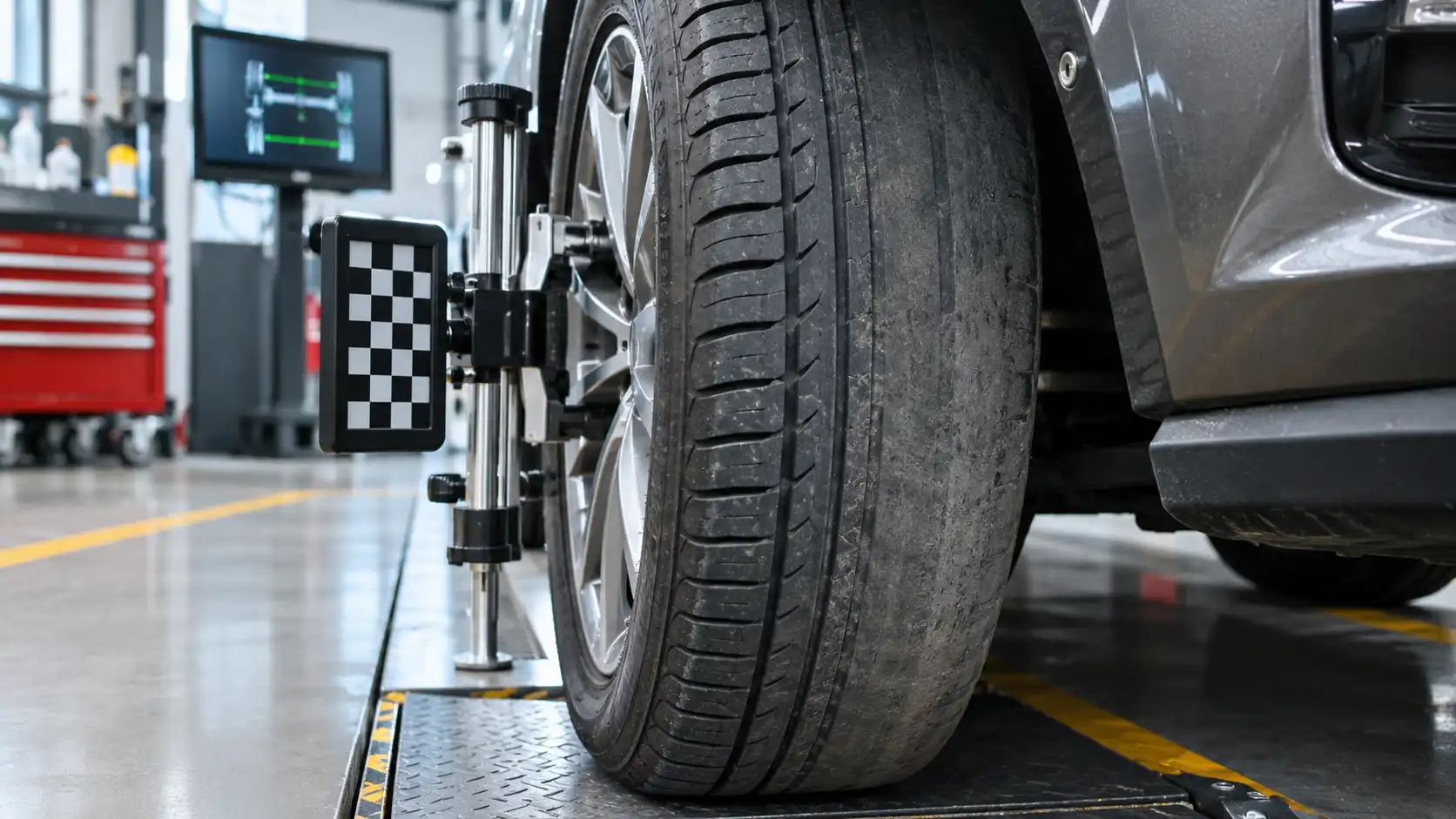
The workshop uses computerised alignment equipment to set camber, caster and toe to each car's factory figures. Wheels are always realigned after tie rod or steering rack work, so repairs finish with the car tracking straight.
Convenience Across Abu Dhabi
The Mussafah workshop is open daily from 9 AM to 9 PM. Free pick-up and drop-off is available anywhere in Abu Dhabi, and every repair is backed by a workmanship warranty. The team works on German, Japanese, American, Korean, Chinese, and premium brands.
Frequently Asked Questions
How do I know if my car needs a wheel alignment?
Watch for a car that pulls to one side, a steering wheel that sits crooked, uneven wear on tyre edges, loose or wandering steering, vibration, or tyres squealing on slow turns. Two or more of these together strongly point to misalignment.
Can I check wheel alignment myself?
You can spot the signs yourself by checking tyre wear and how the car tracks on a straight road. Measuring the actual angles needs computerised equipment, because toe errors of a millimetre or two are invisible to the eye.
How long does a wheel alignment take?
A standard alignment usually takes about an hour when no parts need replacing. If worn tie rods, bushings, or ball joints are found, the time depends on the repair, since those parts must be fixed before the final adjustment.
Does hitting a speed bump affect wheel alignment?
Yes, especially if the bump is taken too fast. A sharp impact can shift the toe setting or bend a steering part. If the car starts pulling or the steering wheel looks off-centre after a hard hit, book a check soon.
Is wheel alignment the same as wheel balancing?
No. Alignment sets the angles of the wheels relative to the car and the road. Balancing evens out the weight around each wheel and tyre to stop vibration. Many cars need both, particularly after new tyres are fitted.
Conclusion
Misaligned wheels announce themselves through a pull, a crooked steering wheel, uneven tyre wear, vague steering, vibration, or squealing tyres. Catching these signs early saves tyres, fuel and suspension parts, and keeps the car stable in UAE heat.
A yearly check and an inspection after any hard impact keep most cars tracking true. Book a precise, computerised wheel alignment with Zenfo Auto Services and get free pick-up anywhere in Abu Dhabi.
Related Articles



Need a hand with your car?
Zenfo Auto Services, Mussafah, Abu Dhabi. Free pick-up, honest quotes.